The headline numbers
Walk & Water runs 3-day rounds, Tuesday to Thursday. These figures cover every settled round from May 19 to October 29, 2026.
- 24 rounds, 144 people and 428 round starts
- 896 walking days and 6,837,537 steps
- Median walking day: 6,860 steps
- Middle half of walking days: about 2,700 to 11,400 steps
- Walking days at 10,000 steps or more: 33%
- Walking days at 7,000 steps or more: 49%
Each day of the round looked about the same
The median walking day was 6,697 steps on day 1, 7,126 on day 2 and 6,854 on day 3. These are three separate groups of days, not the same people followed through the round.
How many rounds get finished
A round counts as finished when at least 2 of the 3 days are logged. Of 428 round starts, 67% were finished and 47% had all three days logged.
First rounds were finished 53% of the time (144 people). Rounds five and later were finished 86% of the time (161 rounds, 25 people). By then the group is mostly people who already finish, so this says more about who stays than about practice.
Who comes back
66% of rounds were followed by the same person starting the next one. Finished rounds were more often followed by another: 83% of finished rounds (247 rounds, 63 people), against 30% of unfinished ones (116 rounds, 69 people). That is a link too: people who are more motivated to begin with are likely to both finish and come back.
Returning walkers also walked more. The median walking day was 8,162 steps for returning walkers and 3,990 in a first round. Part of that is who stays: people already walking more were more likely to return.
Teams: what we can and can’t say
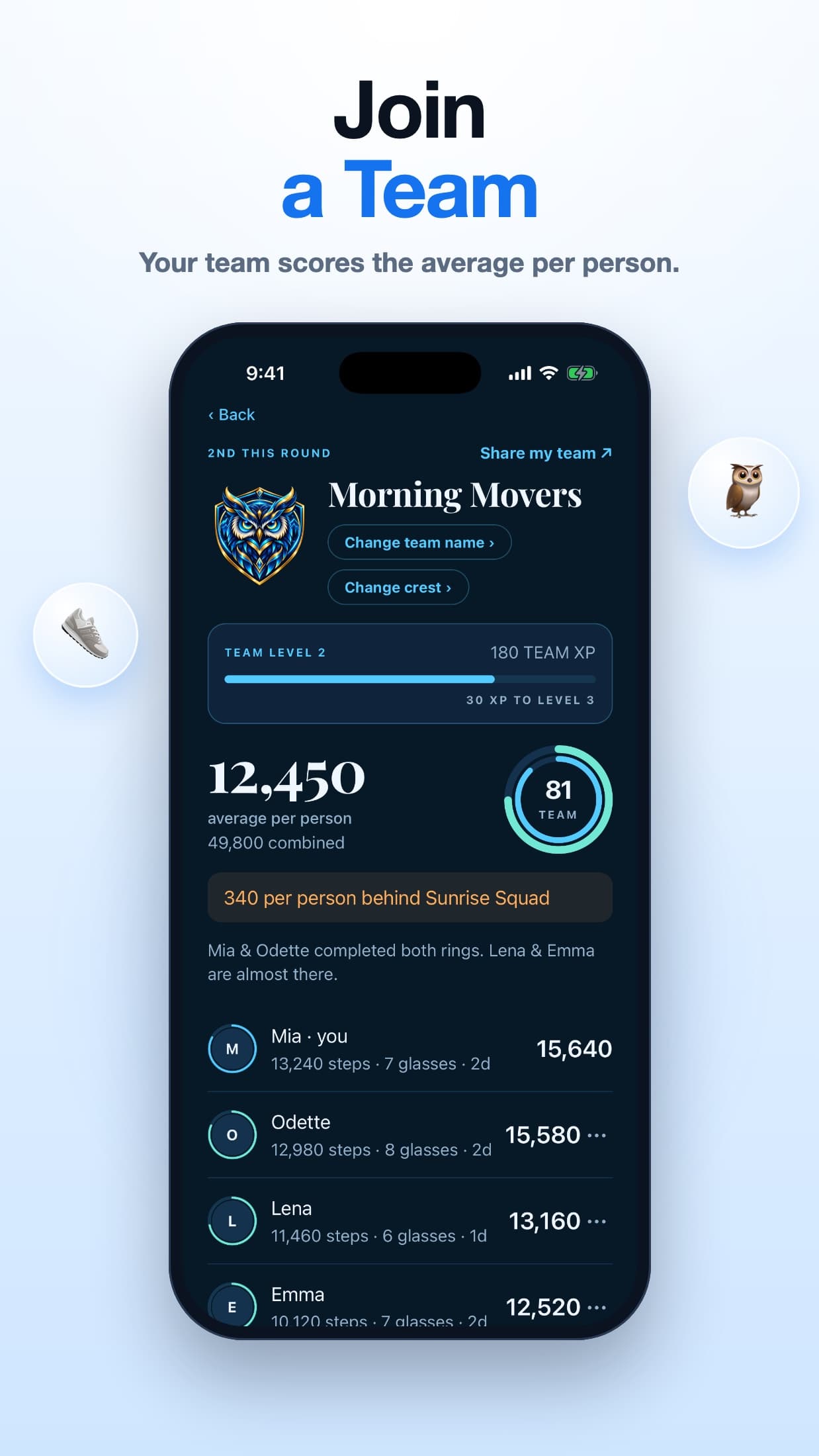
Teams began on August 4, 2026, so these figures cover the 13 rounds since then (352 round starts). Team rounds were finished 81% of the time, against 41% without a team. The gap showed up for first-timers (65% vs 33%; 66 and 51 people) and for returning walkers (87% vs 49%; 37 people each). Team walking days had a median of 7,803 steps, against 4,351 without a team.
The fairest comparison is the same people: 24 walkers who did rounds both ways finished 88% of their team rounds and 71% of the others. Even so, this is a link, not proof. Team members who log nothing for a week are taken off their team, and people who stay active are the ones who stay on teams.
How these numbers compare
A large 2022 analysis of step studies found the benefit of more steps leveled off at about 6,000 to 8,000 steps a day for adults 60 and over, and 8,000 to 10,000 for younger adults. A median walking day of 6,860 sits inside the older range and below the younger one. That analysis looked at risk of death in the general population, not weight, and not challenge walkers.
How the data was collected
Steps are counted by each walker’s phone or watch and synced to the Walk & Water app. A walking day is a round day with steps logged. A round start is anyone who logged steps or water in a round, so finish and return rates include a few people who logged only water.
Phone counts can occasionally run high. A few high days barely move a median, but the share of 10,000-step days may be slightly high. Staff and test accounts are left out, and the round still running is never counted.
Every figure is an aggregate. No one is named, and every group reported has at least 24 people in it. Walk & Water participants chose to join a walking challenge, so they are not a random sample of adults.